
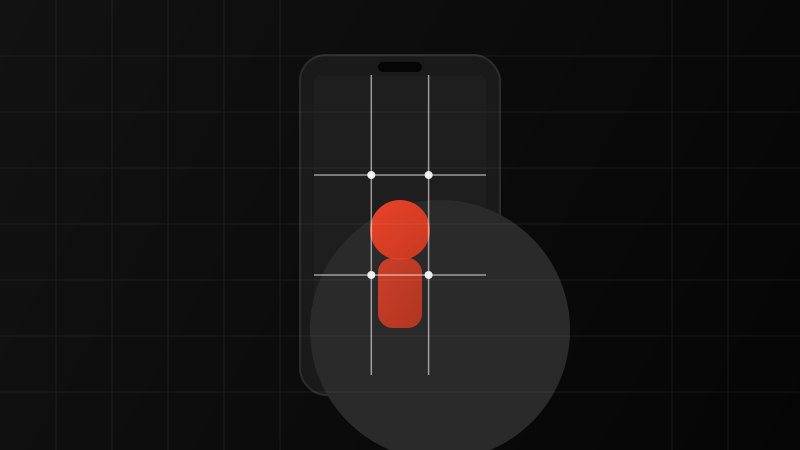
The single biggest jump in photo quality most people ever make has nothing to do with gear. It comes from composition — where you put the subject in the frame, and what you choose to leave out of it. These habits cost nothing, work on any phone, and apply whether you're shooting a portrait, a plate of food, or a street scene.
Use the grid, but don't worship it
Turn on your camera's grid overlay (it's in the settings on every phone camera). The rule of thirds says: instead of centring your subject, place it along one of the lines, ideally where two lines cross. A face near the upper-left intersection, a horizon on the lower third line instead of dead centre — small shifts like these make a frame feel composed rather than snapshot.
It's a starting point, not a law. Centred compositions work great for symmetry, close-up portraits, and anything you want to feel bold and direct. Learn the rule so you know when you're breaking it on purpose.
Give your subject room to look into
If someone in your photo is facing or moving in a direction, leave more space on that side of the frame than behind them. A runner mid-stride with empty space ahead of them reads as motion. The same runner with empty space behind them just looks cramped.
Find a frame within the frame
Doorways, windows, overhanging branches, the gap between two buildings — using something in the scene to frame your subject adds depth and draws the eye exactly where you want it. You don't need to seek these out; once you start noticing them, they show up everywhere.
Clean your background before you shoot, not after
In plain words A great subject with a messy background still reads as a messy photo. Move three steps left before you press the shutter, not after.
A pole growing out of someone's head, a bright window blowing out behind a dim subject, a bin poking into the corner of an otherwise nice shot — these are the things that separate an amateur photo from a deliberate one, and they take seconds to fix by simply changing your position.
Get low, get close, get different
Most photos are taken from standing-eye-height, pointed straight ahead, because that's where your eyes already are. Crouch down to a child's or a pet's eye level. Get closer than feels natural and fill the frame with your subject. Shoot a plate of food from directly above instead of at an angle. Changing your physical position does more for a photo than any filter will.
Light first, then everything else
Soft, directional light — early morning, late afternoon, or an overcast sky — is more forgiving and more flattering than harsh midday sun or a dim room. If a shot isn't working, before you change the composition, try changing where the light is coming from relative to your subject.
The bottom line
None of this requires new equipment. It requires slowing down for the five seconds before you take the photo: where is the subject in the frame, what's behind them, and where is the light coming from. Those three questions, asked consistently, will do more for your photos than any upgrade.
Give it a try
Upload a photo to ZeroPix and see how it holds up. Join a community built for photographers who care about the detail.